Category: review

  • Seceda Sunrise: Behind the Image

    Seceda Sunrise: Behind the Image

    I’m not currently doing much photography so I’ve been getting my landscape fix by watching Alex Nail’s daily image critiques on YouTube. If you haven’t seen Alex’s channel, I highly recommend it – his videos are always high quality, whether made on location or in his office, and are always heavy on content rather than “b-roll” You can count on them to share his thinking behind a particular composition in the field, or decisions being made on the fly during a sunrise or sunset, or to give a self-critical review of images after the fact, again sharing his decision making process about what does and doesn’t work for him.

    Anyway, as I enjoy that aspect of his videos so much, I thought I’d do a few ‘behind the image’ blog posts, sharing what drove my thinking at the point of taking the image, and then going through the processing steps to get to the final image.

    The first image I’ve chosen is one of my favourite images from a trip to the Dolomites in September 2019, and it’s an image that was challenging to take, as well one that has caused me to spend an atypically large amount of time in both Lightroom and Photoshop to process.

    As mentioned in my Dolomites blog posts, Seceda is a well known location that is more than adequately represented on social media. And given our luck with both sunrises and sunsets on this trip, I wasn’t overly confident of (a) getting conditions that would do the location justice, or (b) coming away with anything more than average such an over shot location. So let me walk you through the taking and processing of this image.

    Taking the image

    As may be obvious from the title, the image was taken at sunrise, but the specific location and composition planning was completed the previous afternoon. There are a number of different viewpoints along the ridge with a good few minutes of walking between them, so working out which viewpoint afforded the best compositions ahead of time and any corresponding foreground compositions (as the scale of the view was dictating a fairly wide angle) was time well spent.

    The image straight out of the camera is reproduced below (warts and all) and I want to discuss some of the key points about both the technical aspects and the composition that I think are worth noting.

    A jpeg export of the raw file before making any edits

    Composition

    Now I generally lean towards a more telephoto focal length by default – part in recognition that I am fairly weak at composing wide foregrounds but also I know that it’s easy to give too much weight to an average foreground and leave the focal point that attracted you to the scene in the first place underrepresented, lost in the bigger picture. However, I intentionally shot this wide, at 26mm, as I was keen to step outside of my comfort zone, intending to make use of foreground detail (we’ll come back to this).

    The scene, for me, splits into three fairly balanced vertical strips:

    [ordered_list]

    1. The right hand side – containing the brightest area within the image, the sun, and it’s sun star as it broke the horizon of the mountains. Undoubtably the main focal point.
    2. The middle – containing the peaks of the Seceda range and the mid-ground. These are graphic in shape, dark in tone (contrasting with the bright sun near by) and contain some interesting detail of the low cloud around the peaks.
    3. The left hand side – containing the cloud inversion in the valley below and clear empty sky. A calm counter point to the drama on the middle-right of the frame, offering some negative space to balance things up.

    [/ordered_list]
    My issues with it, in retrospect, are the foreground and the sky. I set out with the intention of including foreground as a challenge to myself, and failed miserably. There isn’t enough foreground there for it to make a meaningful contribution to the scene and there is not enough interest in those grassy knolls to warrant the space in the frame. Additionally, I gave the blank empty sky too much prominence, so really I should have tilted the camera down a little and worked the foreground more to make it more balanced. But that’s easy to say now – in the moment, it was difficult to identify those flaws, whilst trying to ensure I was capturing the images to a technically satisfactory under the pressure of the quickly changing conditions.

    Technical Considerations

    The main considerations here were the sun star, glare/lens flare and the exposure – shooting directly into the sun has implications for all of them.

    Sun stars are a result of diffraction through non-circular apertures (generally the number of points/spikes you see if equal to the number of aperture blades of the lens being used) and are achieved by shooting straight at the sun. More defined sun stars are achieved at small apertures, e.g. f/22, but that will compromise the sharpness across the rest of the frame. In this case, an aperture of f/11 was still adequate to produce a nice, albeit softer, sun star whilst still giving plenty depth of field, as well as being around the optimum aperture for sharpness for the lens.

    Glare and/or lens flare can challenging to control when taking the image and difficult to remove in post-processing. Shooting into the sun will highlight any dirt, dust and marks on your lens (a good reason to avoid using filters if the sun is in the frame as that’s just another layer of glass to cause issues). The flare spots from these marks will typically show as bight circular artefacts, and will be rendered more distinctly at smaller apertures. These can generally be removed by cleaning/wiping the front element.  In the image below, you can see the difference in flare spots at f/22 and f/11 as I tested the appearance of the sun star, making me realise I had to clean the front element of the lens.

    comparison of the sun star and the flare spots at f11 and f22

    You may also get flare spots resulting from internal reflections from the glass elements inside the lens, often appearing as a series of spots or lines across the frame, originating from the light source, with a green or pink colour cast. You generally have to move the position of the sun in the frame to reduce/remove these, but they may be unavoidable (one trick is to shoot a frame with a finger or thumb blocking out the sun and blend later). In the image below, you can see the appearance of lens flare across the frame, making me recompose to minimise the effect (but, as you’ll see, not eradicate it entirely).

    An example of the lens flare across the frame

    With respect to the exposure, the main aim was to ensure that highlights around the sun were not overexposed. I generally shoot in aperture priority mode and use the on-screen aids offered by my Sony A7RII to ‘shoot for the highlights’, i.e. ensure that the frame is exposed such that the highlights are not blown. Shooting into the sun is always going to be difficult, but I took what looked to the a suitable exposure, and then added a couple of stops of exposure compensation to reduce the exposure further, just to make sure (if I’d have been thinking properly, I would have switched to the exposure bracketing drive mode to automate this process and to give that assurance for each image I took).

    Below is a comparison of the two raw files, with the exposure clipping highlights switched on (red areas).  As you can see, the sun is clipped in both exposures, but there sky is still well held in the left hand shot, so this is the image I selected for onward processing (again, I could blend the two exposures, but I like to keep things simple, and the highlights were manageable in the single image).

    Left: f/11, ISO 100, 26mm, 1/160s. Right: f/11, ISO 100, 26mm, 1/400s

    Comparison of two raw failes, taken with a 2 stop exposure difference

    Processing

    Concerned about the poor composition, the first thing I did was see if I could find a crop that worked.  I knew I wanted to get rid of that bottom grassy foreground and balance up the empty sky, i.e. take a sliver of the top and bottom, so a 16:9 aspect ratio was calling out to me.  This simplified the composition significantly for me – there was no longer a competing foreground, detracting from the main event, almost giving that more-telephoto feel that I often lean towards.

    The only problem, compositionally, at that point was then the ‘horizon’.  I’m fairly certain that the camera was level (from my process using my Uniqball tripod head and the on-screen level of the Sony A7RII) however the apparent slope in the clouds on the left hand side of the frame and the upward slope of the mountains on the right hand side of the frame (moving from right to left) all gives the suggestions that the ‘horizon’ isn’t level, so I gave it a small rotation after cropping – you can see the difference below:

    16:9 crop, before straightening the horizon16:9 crop after straightening the horizon

    The next step for me was to make the broad exposure adjustments using the tools in Lightroom’s ‘basic’ panel.  The main adjustments here were to bring the blacks (+8) and shadows (+100) up, the whites (-24) and highlights (-35) down, and then add a boost to the contrast (+58).  These adjustments revealed the detail in the dark cliff face and recovered the clipped highlights of the sun whilst still retaining a very natural brightness to the sun:

    16:9 crop after straightening the horizonthe image after exposure adjustments made

    The exposure adjustment then drew my attention to the lens flare in the mid-bottom-right of the frame, below the sunstar covering the grass and a portion of the cliff face.  I set about trying to correct this with the brush tool, creating a mask on which I could adjust the exposure/contrast to try and neutralise the effect of the flare.  Giving the before/after like this, the edit is really obvious, but I hope if you came to this image without being told, you wouldn’t know…

    the image after exposure adjustments madeAfter image

    There were a couple of other flare artefacts remaining at this point, but I decided to leave those to address in photoshop later on.  At this point, the gross edits are done, and now it was onto some finer, detailed, finishing touches.  First up, a couple of brush edits, to accenutate some detail in the cliff face and to give a little boost to the highlights on the grassy slope in the middle of the image.  Also, a small radial filter covering the sunlit cloud and peaks (just above the grassy slope in the middle of the image) to add a little bit of clarity (+10), to further incease the detail in that fine cloud structure.  Difficult to see in the before/after below, such is the subtlty of the edits, but the aim was to gently enhance the image, not overdo it…

    Before imageAfter image

    I then added a warm split tone to the highlights (hue: 37, saturation: 22, balance: -82) just to add some warmth to the sunrise light.  It’s worth saying that I’m a big fan of split tones, and using white balance to set the mood of an image, rather than always going for complete accuracy.  Correcting  for a true white is challenging in this situation – the clouds on the left of the frame are the only actual white things in the image, but the clouds in shade will be blue in tone, whereas the sunlit cloud will be yellow/orange due to the colour temperature of the sunrise light.  And having experimented with different white balances, I decided to leave it as shot (4900K), but inject some warmth to the just highlights with the split tone (controlled by the balance slider of the split tone panel) rather than the whole image if I had used the colour temperature slider.  This is most noticeable in the bright sky surroungding the sun on the right hand side of the image…

    Before imagethe image after the addition of a warm split tone to the highlights

    The only remaining Lightroom correction then was a check of the spot removal tool, before taking the image into photoshop to remove the final few lens flare artefacts (2 spots in the sunstar and a couple of green/blue tinted artefacts in the bottom left of the frame) as well as a couple of features creeping into the edges of the frame from my crop (e.g. the tops of some grasses in the bottom left corner, and the top of a fence post in the bottom right hand corner).  This is essentially a polishing step that would be too difficult to do in Lightroom, versus the power of the ‘spot healing’ tools in Photoshop.  Focus on the lower half of the left hand third of the image to see the differences…

    the image after the addition of a warm split tone to the highlightsSunrise over Seceda in the Dolomites

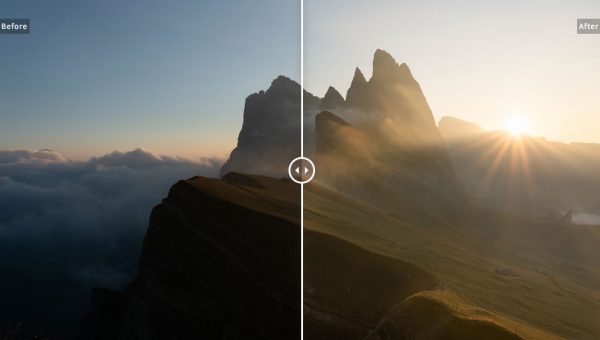
    And so that’s it.  Here is the final image, versus the raw (in the same crop) to showing the full extent of the processing:

    16:9 crop after straightening the horizonSunrise over Seceda in the Dolomites

    This isn’t the first ‘final’ image I’ve reached with this scene.  My initial processing was much darker (as shown in this post), as I love rich contrasts in scenes, but after coming back to the image afresh, I thought it could do with a more naturalistic touch as the orginal edit seemed a little heavy handed.  That’s not to say it couldn’t be more natural still, e.g. by removal of the split tone, but I still wanted to convey a certain look/mood in the image and so settled with what you see above.

    For now, anyway.


  • 2017 Review: #FavouriteFour

    2017 Review: #FavouriteFour

    My first attempt at a review of 2017 ended up being pretty wordy, with no images, so this post is intended to rectify that somewhat.

    The trend this year, on twitter at least, seemed to be for photographers to share their #favouritefour images from 2017.  I quite like sharing my favourite images from the last year so thought I’d join in, but in a slightly longer format with some words accompanying the images (click for larger views).

    1. Snowdon Summit

    Snowdon Summit

    This was taken in the spring, on a weekend in Snowdonia.  We set off, on the Pyg track, in darkness at around 5am aiming to be on the summit not too long after sunrise.  As we climbed and the sun rose, it became apparent that the summit was shrouded in cloud.  As such, we didn’t rush, but made the most of the sunrise light over the Snowdon horseshoe during our ascent.  As we reached the point where the Pyg Track joins the Llanberis path, the cloud started to clear, giving us a fantastic view of the summit through the lifting cloud and a lone walker nearing the summit.  Perfect timing.

    2. Bluebell Woodland

    Bluebell Woodland tilt shift

    In May, I made a trip to Dockey Wood to shoot the bluebells.  I’ve been to this woodland many times, and taken a fair few images of the bluebell woodland, so was keen to try and come away with something different to past visits.  Exploring the woodland, looking for a composition whilst waiting for the sun to get high enough, I came across this scene, with the path winding into the trees near the edge of the wood.  This was one of my first trips out with my Nikon 45mm PC-E tilt-shift lens, so I was keen to put it to use here.  I spent a good 30 minutes in this spot, experimenting with where to put the plane of focus, and selecting the optimum aperture, settling on the above – f/4.8, with the plane of focus approximately in-line with the direction of the path.

    3. From Great Intake

    Great Intake

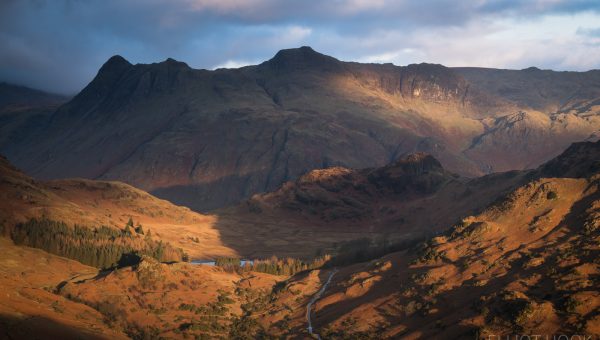
    This was taken on a trip to the Lake District in early December.  It’s a fairly classic view from Great Intake, looking towards the Langdale Pikes, not long after sunrise.  I love this view, and this valley generally, so I’m happy to have been able to capture it in this way.  I really like how the tips of Side Pike are just caught in the sun light as a couple of my favourite images from last year were taken from that exact spot!

    4. Snowy Copse

    snowy copse of trees

    I wrote about this image briefly quite recently.  Taken on a brief wintery spell in mid December, an image I’ve been visualising for around 3 years, finally realised.

    So that’s my favourite four images from 2017.  Pleasingly, two of them are local to me, whilst the other two are from national parks – that seems like a good ratio to aim for, with respect to trying to make the most of what I have locally, versus more distant destinations.  Hopefully, there will be plenty more to follow in 2018.  Happy New Year.


  • 2017 Review

    2017 Review

    Reaching the end of another year, it seems apt to look back at my photographic exploits for the last 12 months.  I do this each year, as a way to review my “progress“, but I haven’t gone as far as writing it up into a blog post for the last few years.

    Progress is a difficult thing to measure. I know I’ve tried to get out more and take more images, but that’s not exactly the progress I’m after (though, it’s a step forward from last year).  I’ve also taken a handful of images of which I am genuinely proud but, again, that’s not really enough for me.

    What I’ve struggled with, as previous years, is to make any headway in identifying and developing my own style, or producing a coherent body of work that sits as one.  That’s obviously not a trivial goal, and it’s not something that I can expect to just happen overnight, but I do know that producing single images, in isolation, is no longer satisfying.

    I have, however, started to understand more around what works for me, from a landscape photography perspective; a greater understanding of what resonates with me, and what I what to communicate to others.  This, I think, has led to progress with respect to what I am choosing to shoot, how I’m choosing to shoot it, and what I look for in the processed result.

    So what do I mean by this?

    I’ve stopped shooting wildlife, now focussing efforts purely on landscape work.  This has been a gradual shift until earlier this year, after my trip to Skomer (which was still awesome, by the way), when I made a decision about my gear that would really take wildlife photography off the table.  I see this as a focussing of the subject matter of my photography, increasing the time spent in the landscape.

    I’ve also realised that I’ve pretty much rejected wide-angle in my own landscape photography.  I see others do it well, but I just struggle to relate to wide-angle compositions when out in the field and even more so when back at home reviewing my images.  I think virtually everything I shot and kept this year (and, in fact, 2016 and 2015) has been at 45 mm or greater barring one or two exceptions.  For me, it’s about finding something within the landscape that speaks to me and capturing it, rather than trying to capture wide-ranging vistas.  That’s not to say I don’t like a good view, I really do, but I just prefer to find something individual within that, isolating it and creating something of my own.  I realised a long while ago that shooting honey pot viewpoints as literal copies of others hold little satisfaction for me.

    In parallel, I’ve also started to gain more satisfaction and enjoyment from shooting out in more rugged landscapes.  As many other landscape photographers, I love nothing more than to be standing on a hillside in rough weather waiting for something special to present itself.  This means I’ve spent more time trying to put myself in interesting places, which means more time whilst carrying all of my kit.  Over time, I became aware of the fatigue resulting from carrying a Nikon D800, fast lenses and a sturdy tripod for long periods and knew that something had to change. Towards the end of the year, I traded all of my Nikon gear for a Sony A7RII, virtually cutting the weight of my kit in half in one fell swoop (more on that in a later blog post), with the aim of making myself lighter and more nimble for future endeavours.

    So narrowing down what I want to shoot and how I want to shoot it is positive movement.  Presenting the output as a coherent portfolio, well, that’s something I’m working on.

    So where does that leave me?  Ultimately, still on a journey, but one that has a clearer aim that, say, 12 months ago.  And with that clearer aim, a more obvious and focussed set of objectives to further the development of my landscape photography over the course of the next year.  Which feels like progress.